October 2026
New simulations offer a compelling explanation for the striking edge-brightened structure in Centaurus A’s jet.
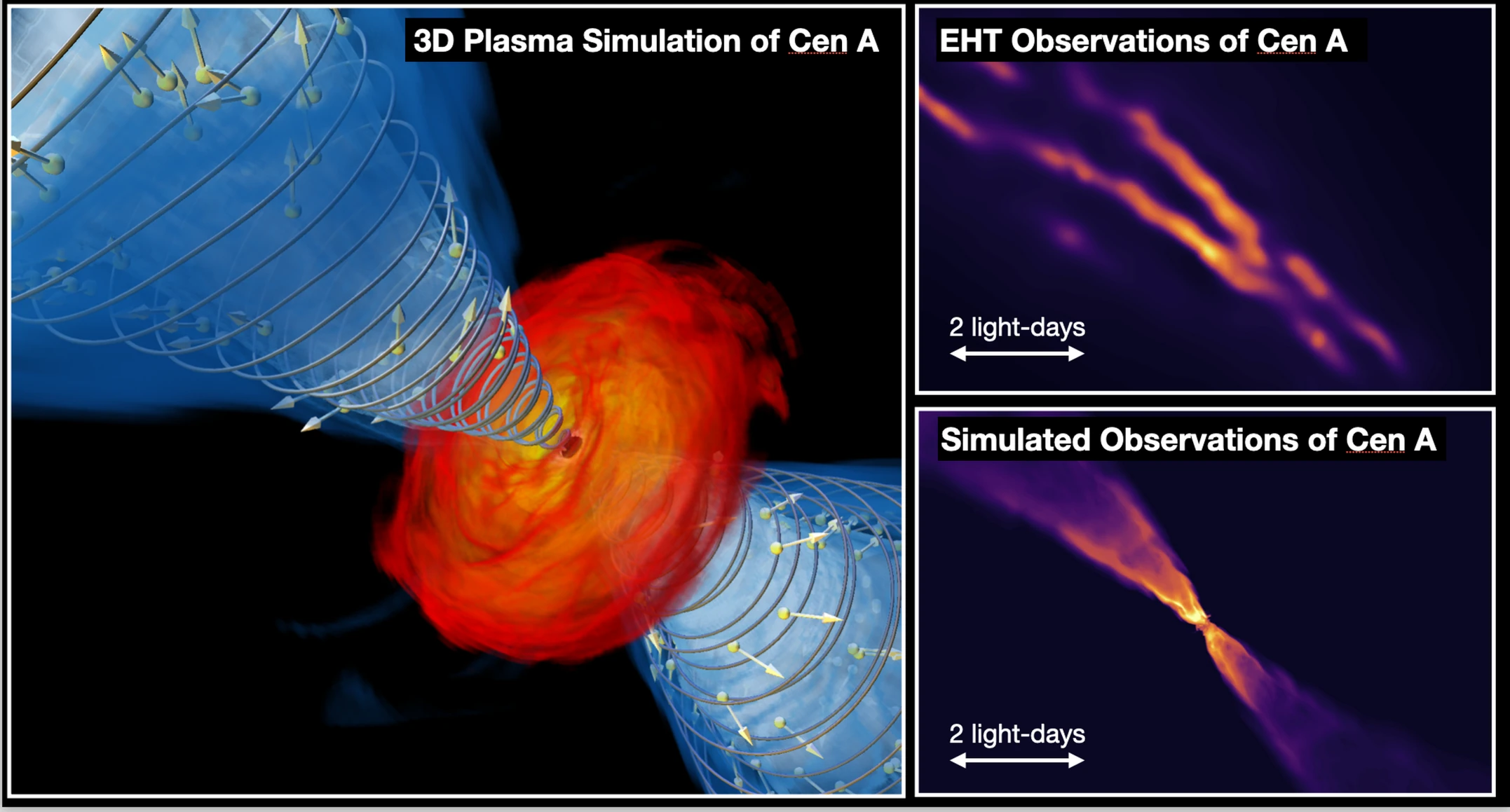
Left: Three-dimensional visualisation of the plasma simulation of Centaurus A. The hot accretion flow surrounding the supermassive black hole is shown in red, the relativistic jets in blue, and the magnetic field structure by grey helical field lines. Coloured particles and arrows illustrate the motion of accelerated particles along the jet.
Top right: Event Horizon Telescope image of the inner jet of Centaurus A at a wavelength of 1.3 mm.
Bottom right: Synthetic EHT observation generated from the new plasma-physics-informed model.
Credit: Christian M. Fromm, Michael Janssen et al. 2021 and Felix Glaser et al. 2026
The active galaxy Centaurus A (Cen A) is located only 12 million light years away from Earth and hosts a supermassive black hole of approximately 60 million solar masses launching a pair of narrow plasma beams, so-called jets, travelling nearly with the speed of light. Due to its proximity to Earth, Cen A is one of the most intriguing active galaxies. Astrophysicists can study its jets with high unprecedented detail, making Cen A a unique laboratory for understanding some of the most extreme environments in the Universe. Observations with the Event Horizon Telescope (EHT) have revealed the structure of the launched jets, showing that the jets are brightest at their edges, not in their centre.
For decades, radio observations have revealed a puzzling feature of relativistic jets launched from supermassive black holes: The edges of the jets often appear brighter than their centers. While theorists have proposed several explanations, existing models have continuously struggled to reproduce the observations consistently.
Likewise, the physical mechanism leading to the edge brightening of Cen A’s jets has puzzled astrophysicists for decades.
Now, new simulations conducted at the Chair for Astronomy at the Julius-Maximilians-University (JMU) Würzburg provide a compelling explanation for the striking edge-brightened structure in Cen A. This research is published in the present issue of the journal Astronomy & Astrophysics.
The new study suggests that the answer lies in the microscopic behaviour of plasma. In the powerful magnetic fields of black-hole jets, energetic electrons travel along magnetic field lines (see left panel in figure). This changes how they emit synchrotron radiation, making the observed brightness depend strongly on the orientation of the magnetic field. Combined with the complex magnetic field geometry of the jet, this effect can naturally produce brighter edges and a comparatively faint centre, just as observed by the EHT in Cen A (see right panels in figure).
Most remarkably, the simulations naturally reproduce the characteristic edge-brightened structure observed in the jet of Cen A. The new model also matches the observations of the EHT at 1.3 mm wavelength with unprecedented detail.
“Cen A is our closest window into the physics of relativistic jets”, said Felix Glaser, Master’s student at the Chair of Astronomy and lead author of the study. “The fact that our plasma-physics-informed model reproduces the observed edge brightening suggests that we are capturing an important piece of the underlying physics. These processes may not be unique to Cen A, but could be common in relativistic jets throughout the Universe.”
The results establish a direct link between microscopic plasma physics and structures spanning several light-days.
“What is truly amazing is that microscopic plasma effects can shape structures on vastly larger scales,” said Dr. Christian Fromm, leader of the Computational Astrophysics Group. “Future observations will reveal even more of these plasma signatures, making it increasingly important to include realistic plasma physics in our models already today and to further investigate the highly non-linear effects of relativistic plasma.”
The findings mark an important step toward connecting observations of black holes with the physics of particle acceleration and radiation. By combining large-scale jet simulations with plasma-physics-informed emission models, researchers can now directly test how plasma processes leave observable signatures across the electromagnetic spectrum.
This result illustrates exactly what we aim to achieve within our DFG Research Unit ‘Relativistic Jets in Active Galaxies’ (FOR 5195),” said Prof. Matthias Kadler, spokesperson of the research unit. “By bringing together expertise in high-resolution observations, numerical simulations and plasma physics, we are making progress toward understanding how black holes launch powerful jets and how these jets produce the radiation we observe. The new study is an excellent example of this approach.”
The study comes at a time when radio astronomy is entering a new era. Future millimetre-VLBI observations will benefit from the addition of new millimetre-wave telescopes, such as the planned Wetterstein Millimeter Telescope (WMT) on Germany’s highest mountain, the Zugspitze, improving the sensitivity, image fidelity and frequency agility of global interferometric arrays. Together with future large international research infrastructures such as the next-generation Very Large Array (ngVLA) and the Square Kilometre Array (SKA), these developments will enable increasingly detailed studies of black-hole jets, from their immediate launching regions to much larger scales.
“A black hole and a future fusion reactor may seem worlds apart, but both are governed by the complex physics of plasma,” said Prof. Karl Mannheim, Chair of Astronomy at JMU. “By studying Cen A, we can observe plasma under conditions impossible to recreate on Earth. These insights help us to understand some of the most energetic phenomena in the Universe while contributing to the broader scientific knowledge that underpins future fusion-energy technologies.”
The work opens the door to a new generation of plasma-physics-informed, data-driven models of black-hole jets helping to demystifying nature’s most powerful particle accelerators.
Original Paper:
Probing anisotropic particle acceleration and limb brightening in Centaurus A’s jet,
Astronomy & Astrophysics, 12 October 2026,
doi: 10.1051/0004-6361/202660093
Further Links:
Event Horizon Telescope:
https://eventhorizontelescope.org/
Contact:
Dr. Christian M. Fromm
Research Group Leader Computational Astrophysics
Julius-Maximilians-Universität Würzburg
Lehrstuhl für Astronomie
Emil-Fischer-Str. 31
97074 Würzburg
Phone: +49 931 31-81981
christian.fromm (at) uni-wuerzburg.de