Annual Assembly 2026

The annual assembly 2026 will take place as a three-day meeting on 9 – 11 March in Würzburg.

The meeting is the annual gathering of all members and associated researchers of our research unit as well as of selected experts external to the research unit. Participants will have the opportunity to present their research topics, their numerical, computational or analytical techniques, their barriers and obstacles to progress, current difficulties and immediate problems as well as their near-future goals. There will also be ample space to discuss conceptual models, recent findings up to now, as well as to plan future starting points of research. We will gain insight about different approaches, about solution finding and we will especially plan future collaborations and potential synergies and enrich our colleagues’ work with fruitful hints.

For additional information and for the schedule, registered participants may visit this page with more detailed information.
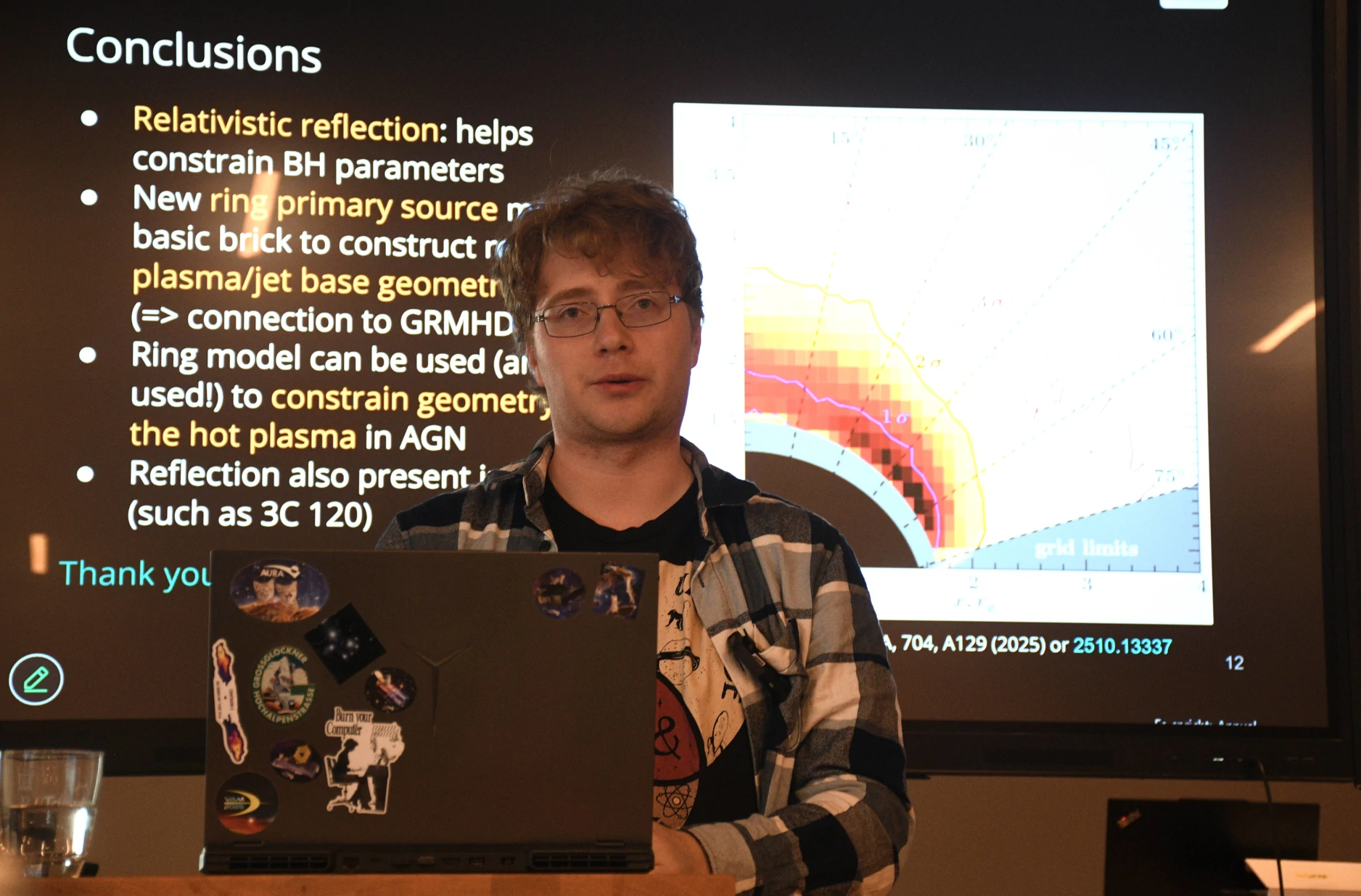
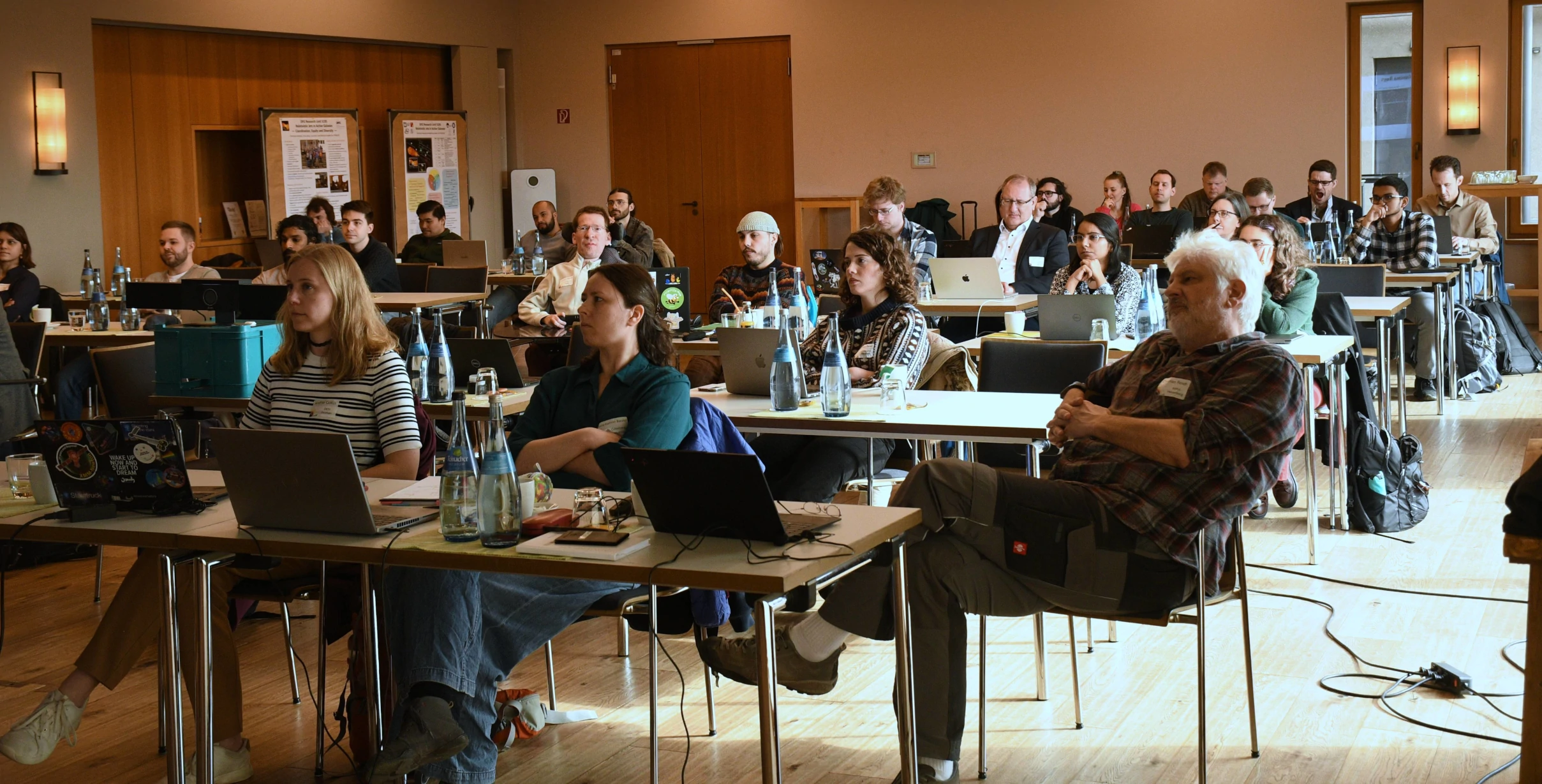
Impressions from annual assembly 2025, Credit: Hrishikesh Shetgaonkar
Scientists of our project P2 have examined the X-ray spectrum of the nearby Seyfert-2 galaxy ESO 033-G002, which exhibits prominent relativistic reflection and a strong broad 6.4 keV iron Kα line. Panel (a) shows data from XMM-Newton and NuSTAR. In a study performed by Alexey Nekrasov, it was demonstrated (panel b) that the spectrum can be reproduced assuming a ring-like primary source that illuminates the accretion disk, resulting both in relativistic reflection (relxill refl) and direct emission (relxill prim), a distant reflector (xillver), a scattered nuclear component (nthComp), as well as emission from collisionally ionised diffuse plasma (apec). It was found that the primary source is located within three gravitational radii from the black hole. Credit: "Relativistic reflection within an extended hot plasma geometry", A. Nekrasov et al., A&A, 2025
Scientists of our project P2 have examined the X-ray spectrum of the nearby Seyfert-2 galaxy ESO 033-G002, which exhibits prominent relativistic reflection and a strong broad 6.4 keV iron Kα line. Panel (a) shows data from XMM-Newton and NuSTAR. In a study performed by Alexey Nekrasov, it was demonstrated (panel b) that the spectrum can be reproduced assuming a ring-like primary source that illuminates the accretion disk, resulting both in relativistic reflection (relxill refl) and direct emission (relxill prim), a distant reflector (xillver), a scattered nuclear component (nthComp), as well as emission from collisionally ionised diffuse plasma (apec). It was found that the primary source is located within three gravitational radii from the black hole.
Credit: “Relativistic reflection within an extended hot plasma geometry”,
A. Nekrasov et al., A&A, 2025, DOI: 10.48550/arXiv.2510.13337