02.02.2026:
How are relativistic jets launched from the immediate vicinity of supermassive black holes? New results presented by the Event Horizon Telescope (EHT) collaboration provide important new insights into this question and directly connect to the goals of our FOR5195 Project P1.
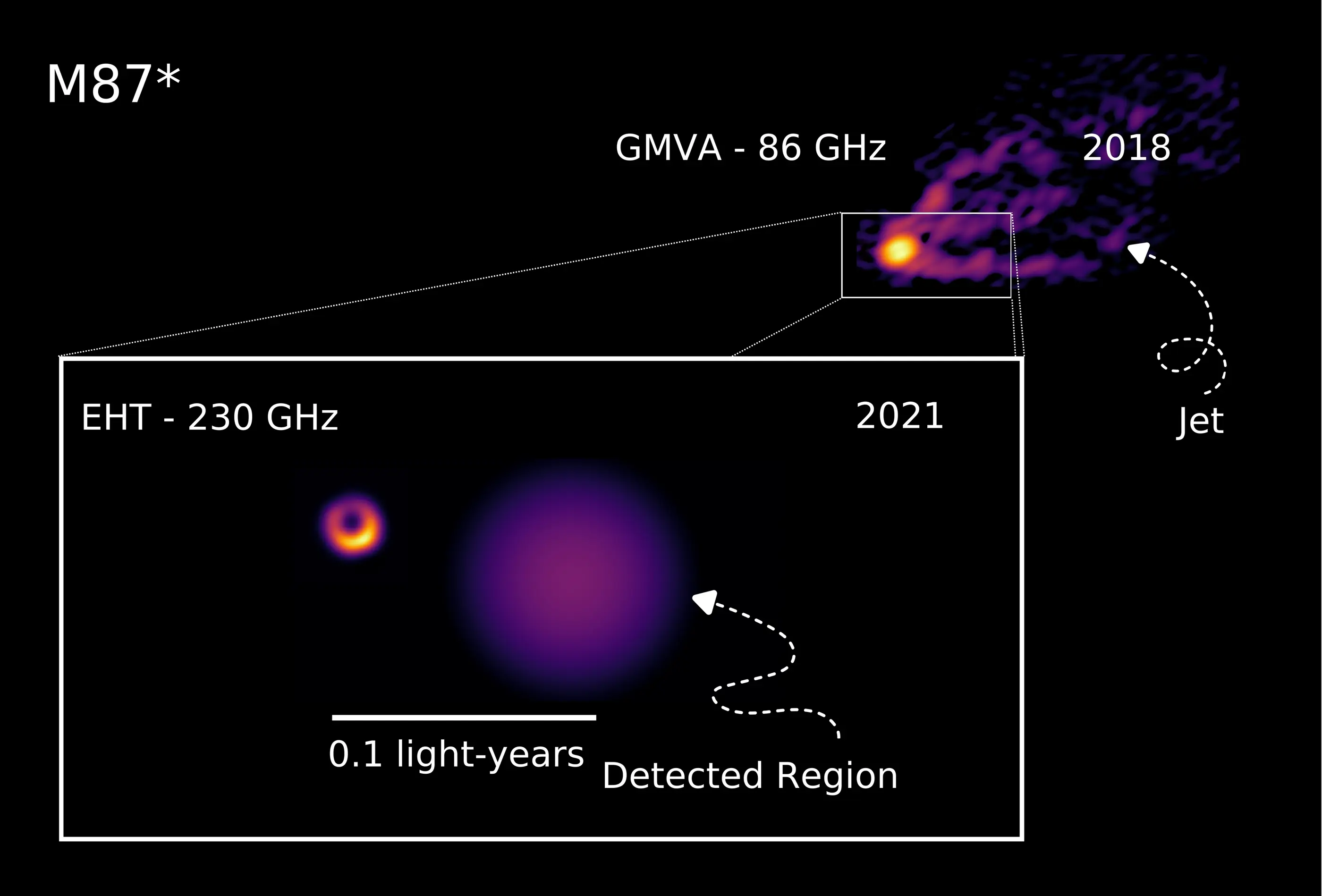
In a study published in Astronomy & Astrophysics on 29 January 2026 by Saurabh and collaborators, the EHT reports high-resolution observations of the supermassive black hole in Messier 87 at 1.3 mm wavelength. While the observations clearly resolve the bright ring surrounding the black hole, the analysis shows that this structure alone cannot account for all of the observed emission. An additional compact component is required, spatially consistent with the base of the southern relativistic jet, previously identified at 3.5 mm wavelength with the Global mm-VLBI Array (GMVA). This establishes a direct observational link between the accretion flow near the event horizon and the emerging jet.
The publication includes contributions from several members of our research unit FOR5195, underlining the close connection between these results and Project P1, which combines 1.3 mm EHT and 3.5 mm GMVA VLBI imaging with state-of-the-art GRMHD and radiative-transfer modelling. The Messier 87 study demonstrates the power of this approach and provides a key reference for extending similar analyses to other active galactic nuclei within FOR5195.
More information:
Press release by Max-Planck-Institut für Radioastronomie
Original publication at Astronomy & Astrophysics
DFG Research Unit (Forschungsgruppe) FOR 5195 – Relativistic Jets in Active Galaxies
Funded by the Deutsche Forschungsgemeinschaft (DFG, German Research Foundation)