January 2026:
New simulations reveal how energetic particles and magnetic eruptions shape the glowing ring around M 87’s black hole.
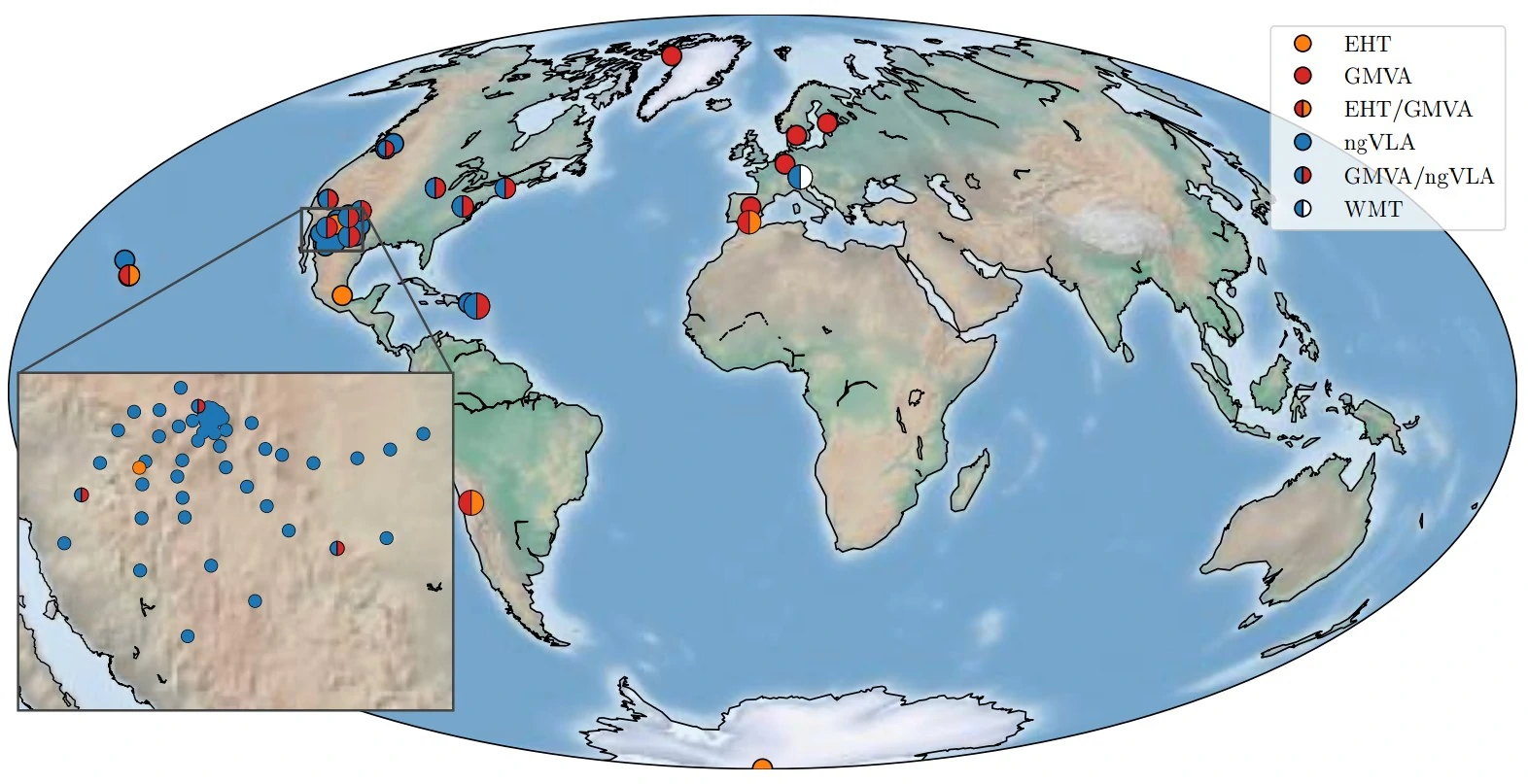
Researchers at the Chair of Astronomy at the Julius-Maximilians-Universität Würzburg have resolved a longstanding puzzle in black hole observations: Why the supermassive black hole in the galaxy M 87 shows different ring sizes at two radio frequencies. Their work combines state-of-the-art 3D supercomputer simulations with the latest observations from two global radio-telescope networks, the Event Horizon Telescope (EHT) and the Global Millimeter VLBI Array (GMVA). These arrays link antennas across the globe, including telescopes in Antarctica and Greenland forming an Earth-sized virtual telescope. The results of this study appeared quite recently in Astronomy & Astrophysics.
M 87: A Unique Laboratory
The galaxy M 87, a mere 55 million light-years away, hosts a black hole 6.5 billion times the mass of the Sun. It became iconic in 2019 as the first black hole ever imaged and is known for its powerful jet stretching thousands of light-years. Because M 87 is large, bright and relatively nearby, it offers a rare opportunity to study how black holes feed on surrounding matter and launch jets.
The black hole itself is invisible, but the superheated plasma swirling around it glows. Gravity bends this light into a bright ring surrounding a darker “shadow”, offering clues about the black hole and the extreme physics near it.
Why the Ring Appears Different at 230 GHz and 86 GHz
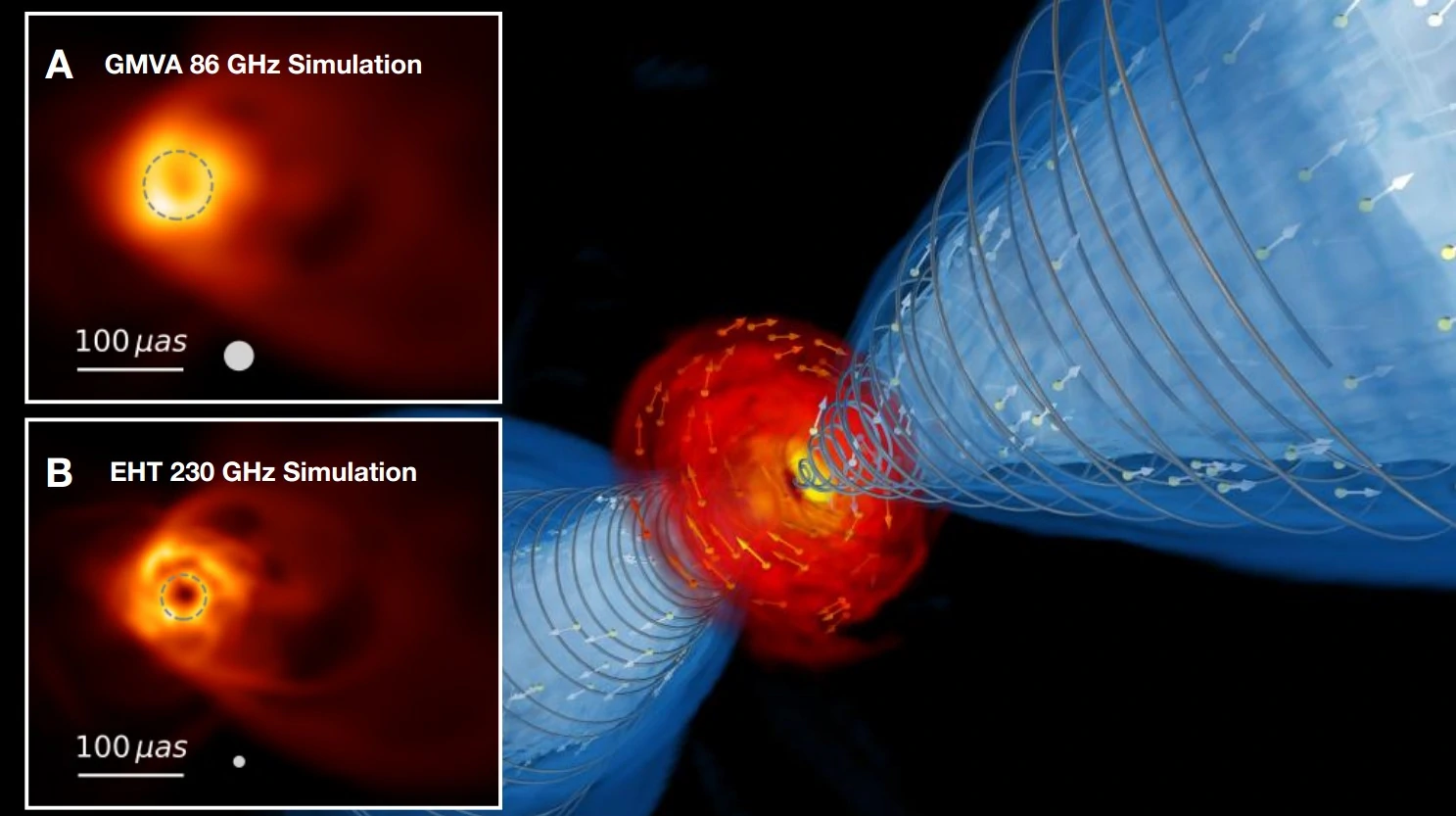
The EHT observed a ring about 42 microarcseconds wide at 230 GHz – similar to spotting an
orange on the Moon. Later GMVA observations at 86 GHz found a larger ring, about 64
microarcseconds across. The new simulations show that this difference is actually expected:
- At 230 GHz, radiation comes mostly from lower-energy electrons in the hot accretion disk near the black hole.
- At 86 GHz, the emission is dominated by high-energy electrons in the jet, making the
system appear larger. - Magnetic eruptions near the black hole can inject bursts of energetic plasma into the jet, further enhancing its brightness at lower frequencies.
“It’s like looking through fog of different thickness, occasionally lit by flashes”, says lead author Ainara Saiz-Pérez, doctoral researcher in Würzburg and leading author of the publication. “At higher frequencies, we mainly see the hot disk. At lower frequencies, we also see the energised jets and magnetic eruptions, making the ring appear larger.”
A Unified Picture of M 87
By producing realistic “virtual telescope” images from their simulations, the team showed that both the 230 GHz and 86 GHz observations fit within a single physical model. Rather than conflicting, the two frequencies reveal different layers of the same system.
“These results offer unprecedented insight into how jets form and how particles are accelerated”, says Dr. Christian M. Fromm, head of the Computational Astrophysics group in Würzburg. “They highlight the strength of combining advanced theoretical modelling with cutting-edge observations.”
Support and Future Prospects: Wetterstein and the ngVLA
This project showcases the strength of DFG Research Units. “We integrate theory, simulations and observations. Our Research Unit FOR 5195 allowes us to bring all
the pieces together and solve this puzzle. With the planned Wetterstein Millimeter Telescope (WMT), we are adding an essential new piece to this global effort.” says Prof. Dr. Matthias Kadler, speaker of the Research Unit.
The planned WMT on the Zugspitze will join the global network of radio observatories operating at the key frequencies used to study black holes. It is designed to participate in observations with both the Event Horizon Telescope (EHT) and the next-generation Very Large Array (ngVLA), a major US-led facility now under development. The real scientific power comes from combining these facilities.
Linking the WMT with the EHT and the future ngVLA will provide sharper images, higher
sensitivity and far better sky coverage than any si ngle observatory alone. Together, they will allow astrophysicists to probe the disk-jet coupling region where infalling matter, intense magnetic fields and the immense gravitational pull of the black hole interact to launch relativistic jets with unprecedented detail. This combined power paves the way not only for sharper images, but for true “movies” capturing a black hole in action.
“Together, these efforts will advance our understanding of how black holes grow, how they energise their surroundings and how some of the universe’s most powerful phenomena are produced”, concludes Prof. Dr. Karl Mannheim, Chair of Astronomy at the University of Würzburg.
Original research paper:
Ainara Saiz-Pérez, Christian M. Ainara, Yosuke Mizuno, Matthias Kadler, Karl Mannheim, Ziri Younsi, 2026, “Probing the disk-jet coupling in M 87”, A&A 705, 156
DFG Research Unit (Forschungsgruppe) FOR 5195 – Relativistic Jets in Active Galaxies
Funded by the Deutsche Forschungsgemeinschaft (DFG, German Research Foundation)